Careers in Physics
- What is Physics?
Physics is the study of matter and energy and their interactions. The fundamental ideas of physics underlie all of the basic sciences -
astronomy, biology, chemistry, and geology - and all of applied sciences and engineering.
There is more here
on the American Physical Society webpage.
- What do physics majors do?
Richmond Physics graduates have followed many different paths after leaving the University as teachers, scientists, engineers,
physicians, lawyers, and problem solvers in industry.
They are well equipped for new fields like data science.
They have gone on to scientific careers at places
like Princeton, Chicago, MIT, North Carolina, and Virginia in fields from particle physics to planetary science.
Perhaps you too want to join the Adventure!
You can find more stuff
here and here and
here.
- How does physics help?
Majoring in physics is superb preparation for virtually all careers.
Physics majors do well on professional school testing -
data on the LSAT (for law school) and the MCAT (for medical school) is
here.
More information on getting jobs is here.
- What do physics majors make?
Lots. See the articles on salaries and the current job market for physicists from the
American Physical Society, the
Institute of Physics in the UK, and the
American Institute of Physics.
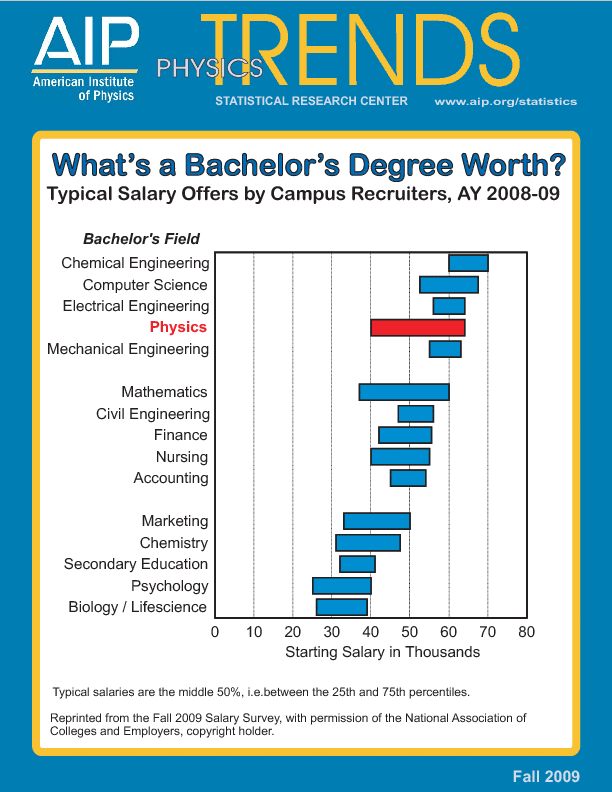
Check out the graphic
here that is based on survey data from the National Association of Colleges and Employers.
On a national scale Physics is the highest earning major offered by the University of Richmond.
More detailed information is in the next entry.
More recently and after the financial collapse of 2008,
physics major starting salaries remain high as reported here.
There is some more information here (warning: has ads).
- Earning Potential of a Bachelor's degree in Physics
A study by the National Science Foundation and the
Bureau of Labor Statistics examined the earning potentials of
all Bachelor degree holders in the United States
(
Daniel E. Hecker, Earnings of College Graduates,
Monthly Labor Review, December, 1995, p. 3).
Wage earners were separated into three categories---(i)
young (aged 25-34), (ii) midcareer (aged 35-44), and (iii)
older (aged 45-64).
Physics degree holders are continually ranked amongst the highest
for all age groups. In the young group, Physics is ranked fourth at
13% above the median and trailing only Pharmacy, Engineering, and
Computer Science.
In midcareer Physics is ranked fifth at 16% above
the median (behind Engineering, Mathematics, Pharmacy and Computer
Science).
In late career, Physics is number 1 at 25% above the
median! Note that Physics majors typically have a higher earning
potential than many majors that would be thought to create high
wage earners
(like economics, business, accounting, etc.).
A survey by the Department of Labor for the
Washington, DC area shows that Physicists are the fourth highest
wage-earners (below Lawyers, Dentists, and Doctors) in the
Professional, Paraprofessional, and Technical occupation
category and are compensated at rates that are typically
10-25% higher than traditional engineers.
The Physicist median compensation is $36.36 per hour.
Overall, Physicists are the FIFTH highest wage-earners
out of approximately 500 job categories surveyed by the
Department of Labor. Further details can be found at the DOL study.
A Physics degree has the highest potential for earnings than
nearly any other field!
- Who's hiring?
The American Institute of Physics keeps a webpage
here on hiring
opportunities for people with bachelors degrees in physics and reports on past hiring information
here.
- On to graduate school!
If you are interested in building your physics education
beyond college, there is useful advice
here and
here.
More specific guidance is on our site
here.
- Importance of science training in the workforce -
Even workers in non-technical fields find that scientific
training gives them an advantage in the workplace.
There is more
here from a survey by the National
Science Foundation.
-
Careers For more information on jobs and graduate and professional school
opportunities in physics see here.
At the
Statistical Research website of the
American Institute of Physics (AIP)
they discuss surveys
of people with doctorates, master's degrees and bachelor's degrees in physics.
- Look for a job now! Here
on the AIP website.
- Success Stories Some of the places where physicists end up are
described here
from the American Institute of Physics.
- Surprises! Unique careers of 'hidden physicists'
are
here.
-
Does It Matter Where I Go to College?
|